Skip to content
  • Categories
  • Recent
  • Tags
  • Popular
  • World
  • Users
  • Groups
Skins
  • Light
  • Brite
  • Cerulean
  • Cosmo
  • Flatly
  • Journal
  • Litera
  • Lumen
  • Lux
  • Materia
  • Minty
  • Morph
  • Pulse
  • Sandstone
  • Simplex
  • Sketchy
  • Spacelab
  • United
  • Yeti
  • Zephyr
  • Dark
  • Cyborg
  • Darkly
  • Quartz
  • Slate
  • Solar
  • Superhero
  • Vapor

  • Default (No Skin)
  • No Skin
Collapse

Lizard-LLM Community

administrators

Private

Posts


  • Lizard inference engineering: Run the real HTTP readiness check
    L lizardadmin

    Inference Engineering · Day 30 · Evening
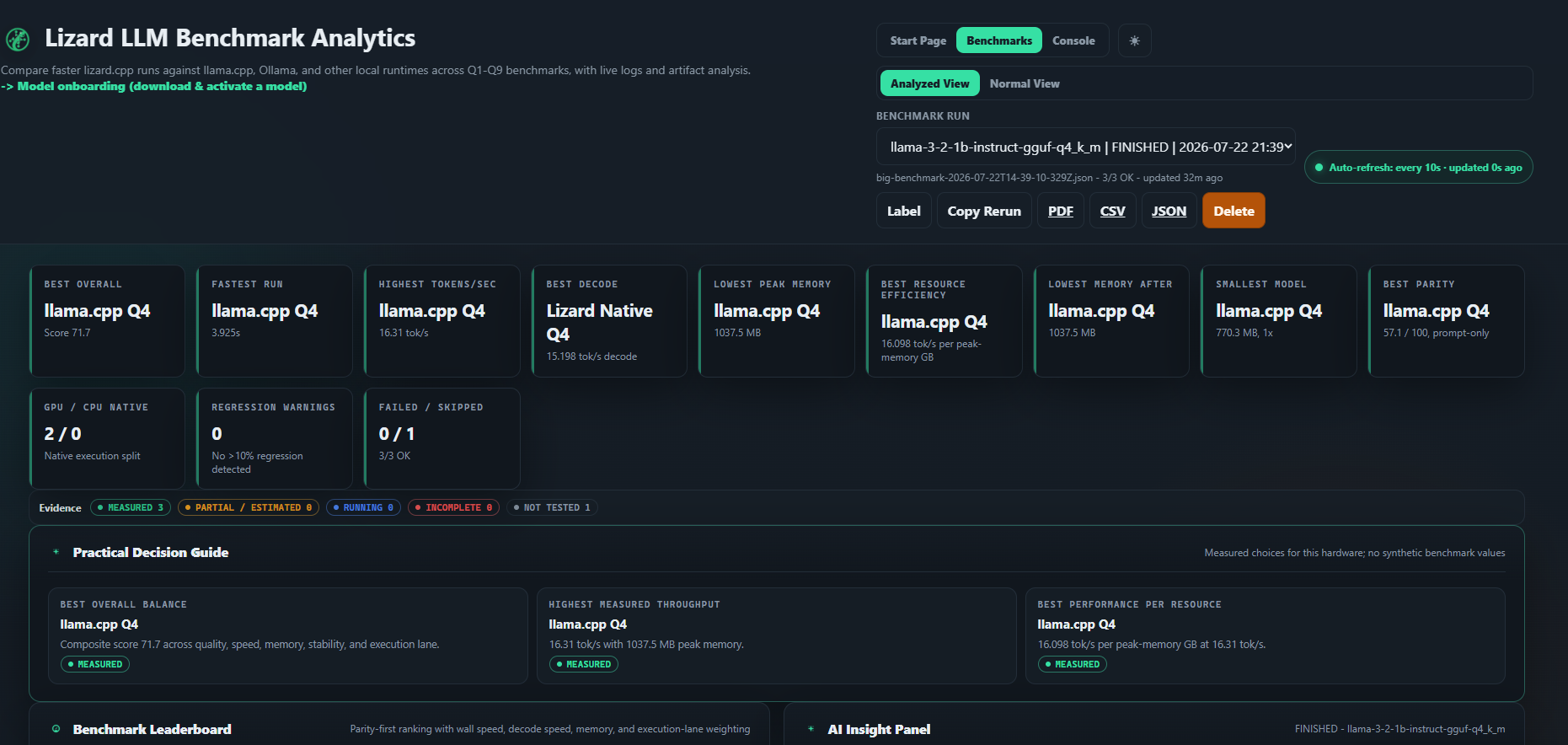
    Run the real HTTP readiness check editorial visual — lizard-llm.qendryx.com

    If you want a readiness check that means something, run the HTTP benchmark against a real model file instead of a toy case. The useful part here is not the peak number on a single pass. It is the comparison across the same GGUF with two batch sizes, B=16 and B=8, and the ability to line that up against llama.cpp on the same host.

    That matters because batch size changes the shape of the request. A model can look healthy at one setting and expose a different bottleneck at the other. Memory pressure, launch overhead, and decode behavior do not always move together. When you keep the artifact constant and only change the runtime lane, you get a cleaner view of what the engine is actually doing.

    The practical habit is simple: capture the command, keep the GGUF path fixed, save the benchmark artifact, and record the hardware context along with the result. That gives you something a second person can rerun later without guessing which variable changed.

    I have found that the most useful benchmark writeup answers three things: did the model load, did the request complete, and where did the two runtimes diverge under the same input. If you only keep one number, you lose the signal.

    What model and Windows machine would you use as the first real HTTP readiness check?

    hashtags":["LizardLLM","HTTPBenchmark","llamaCpp","GGUF","InferenceEngineering"]},

    Engineering fact: The Lizard Console command lizard-llm benchmark http can test lizard-native or Caterpillar at B=16 and B=8 and compare the same GGUF with llama.cpp.

    Lizard The AI Runtime You'll Own—Not Rent.

    Receive two professional Windows AI runtimes with lifetime updates. Run AI at native speed, keep every conversation private, and stay independent with intelligent hardware optimization and no cloud dependency.

    Read the relevant Lizard page

    #LizardLLM #HTTPBenchmark #llamaCpp #GGUF #InferenceEngineering

    <!-- lizard-marketing-slot:day-30-pm -->
    Architecture

  • Lizard inference engineering: Performance leadership must be re-earned on each machine
    L lizardadmin

    Inference Engineering · Day 30 · Morning

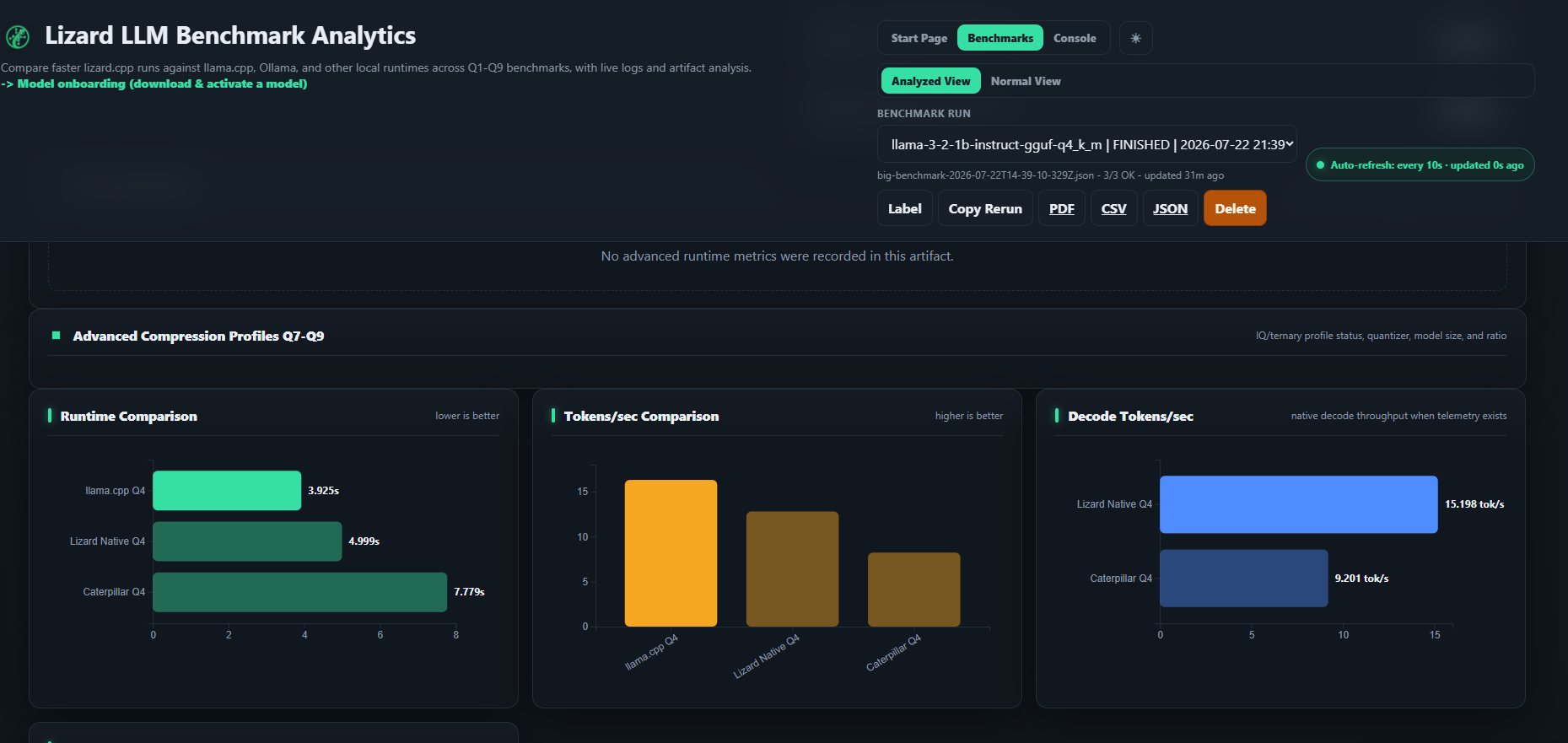
    Performance leadership must be re-earned on each machine editorial visual — lizard-llm.qendryx.com

    Performance leadership is evidence with boundaries, not a permanent badge.

    A benchmark that omits hardware, model weights, quantization, context, concurrency, transport, and correctness makes it too easy to generalize a result past the machine that produced it. Lizard’s benchmark tooling keeps those fields together so a fast run stays scoped to the exact setup that produced it.

    That matters in practice. The same model can look different when the context window changes, when concurrent requests arrive, or when the transport path changes from one local route to another. If correctness is not recorded alongside speed, you can end up optimizing a failure mode and calling it progress.

    The useful habit is simple: publish the evidence you would want back when the result is challenged. Record the machine, the quant, the load shape, and the correctness gate before you compare one run to another. That does not slow the work down; it keeps the work honest.

    How do you usually fence a benchmark so a local win does not get repeated as a universal claim?

    Engineering fact: Lizard's benchmark tooling records hardware, model, quantization, context, concurrency, transport, and correctness so a local win remains scoped instead of becoming a universal claim.

    Lizard The AI Runtime You'll Own—Not Rent.

    Receive two professional Windows AI runtimes with lifetime updates. Run AI at native speed, keep every conversation private, and stay independent with intelligent hardware optimization and no cloud dependency.

    Read the relevant Lizard page

    #localai #benchmarking #inference #llmops #performanceengineering

    <!-- lizard-marketing-slot:day-30-am -->

    Benchmarks

  • Lizard inference engineering: Community questions should keep users anonymous
    L lizardadmin

    Inference Engineering · Day 29 · Evening

    Community questions should keep users anonymous editorial visual — lizard-llm.qendryx.com

    Community incident workflows work better when they separate the technical problem from the person who hit it.

    If a major failure is shared to the Lizard Community, the workflow publishes an anonymized topic and keeps personal user information out of the public discussion. That matters more than it sounds. Once a thread carries a name, account detail, or other identifying context, people start answering the person instead of the failure mode. The result is usually less useful debugging and more friction around what should have been a clean technical exchange.

    The practical pattern is simple: store the private incident record where it belongs, then open the public discussion with only the facts that help others reproduce, recognize, or explain the issue. Keep the Ticket ID linkage behind the curtain. Keep the public thread focused on symptoms, environment, model or runtime behavior, and the steps already ruled out. That gives engineers enough surface area to reason about the fault while preserving the user’s privacy boundary.

    I like this design because it lowers the cost of asking for help. People are more willing to report a failure when they know the community thread will not expose them by default. It also keeps the public archive cleaner for future readers, since anonymized incident titles are easier to search, group, and reuse than threads built around a single user’s account history.

    What diagnostic details have you found are safe to share publicly without turning the thread into a privacy risk?

    Engineering fact: When a major failure is shared to the Lizard Community, the incident workflow publishes an anonymized topic and keeps personal user information out of the public discussion.

    Lizard The AI Runtime You'll Own—Not Rent.

    Receive two professional Windows AI runtimes with lifetime updates. Run AI at native speed, keep every conversation private, and stay independent with intelligent hardware optimization and no cloud dependency.

    Read the relevant Lizard page

    #privacy #incidentresponse #communitysupport #debugging #softwareengineering

    <!-- lizard-marketing-slot:day-29-pm -->

    Architecture

  • Lizard inference engineering: Make benchmark commands copyable and complete
    L lizardadmin

    Inference Engineering · Day 29 · Morning

    Make benchmark commands copyable and complete editorial visual — lizard-llm.qendryx.com

    Reproducibility begins with a complete command.

    Lizard's HTTP benchmark command exposes the provider, model identity, exact GGUF path, concurrency lanes, and token budget. The llama.cpp comparison uses the same artifact unless the operator explicitly skips it.

    The command becomes part of the evidence, not an undocumented setup detail.

    Could someone reproduce your latest performance claim from the command you published?

    Engineering fact: Lizard documents the provider, model, GGUF path, concurrency lanes, token budget, and optional llama.cpp comparison in one HTTP benchmark command.

    Read the relevant Lizard page

    #LizardLLM #LLMInference #Benchmarking #LocalAI #PerformanceEngineering

    <!-- lizard-marketing-slot:day-29-am -->

    Benchmarks

  • Lizard inference engineering: Do not turn unavailable telemetry into zero
    L lizardadmin

    Inference Engineering · Day 28 · Evening

    Do not turn unavailable telemetry into zero editorial visual — lizard-llm.qendryx.com

    Zero is a measurement; missing is a state.

    When resource or performance telemetry is unavailable, Lizard preserves that absence instead of writing zero. A zero could incorrectly imply the GPU was measured and idle, the provider generated no tokens, or the path failed.

    Honest missing data protects later comparisons from a false baseline.

    Where in your dashboards could an empty value be silently turning into zero?

    Engineering fact: Lizard preserves missing resource or performance fields as unavailable rather than converting them to zero, which would falsely imply measured inactivity or failure.

    Read the relevant Lizard page

    #LizardLLM #LLMInference #Benchmarking #LocalAI #PerformanceEngineering

    <!-- lizard-marketing-slot:day-28-pm -->

    Benchmarks

  • Lizard inference engineering: Keep user metrics attached to the response
    L lizardadmin

    Inference Engineering · Day 28 · Morning

    Keep user metrics attached to the response editorial visual — lizard-llm.qendryx.com

    A separate dashboard is useful, but the response already knows how it was served.

    Lizard's native HTTP response metadata can carry the current user-visible measurement, the comparable history summary, runtime provider, and selected concurrency policy. The client can inspect the result without guessing which backend handled it.

    Observability is strongest when it travels with the event it describes.

    Which serving details would your client application surface beside a local AI response?

    Engineering fact: Lizard's OpenAI-compatible native response metadata can include the current HTTP measurement, historical user summary, provider identity, and concurrency policy.

    Read the relevant Lizard page

    #LizardNative #LizardLLM #LocalAI #GGUF #InferenceEngineering

    <!-- lizard-marketing-slot:day-28-am -->

    Architecture

  • Lizard inference engineering: Context length belongs in lived performance history
    L lizardadmin

    Inference Engineering · Day 27 · Evening

    Context length belongs in lived performance history editorial visual — lizard-llm.qendryx.com

    Conversation length changes the workload before decode begins.

    As context grows, prompt processing and KV-cache pressure can change even when the model and hardware stay the same. Lizard records context tokens and includes a context bucket in comparable turn history.

    That keeps a long-conversation slowdown from looking like an unexplained engine regression.

    At what context length does your current local model begin to feel different?

    Engineering fact: Lizard records context tokens and groups native turn history into context buckets because longer conversations change prefill and KV-cache costs.

    Read the relevant Lizard page

    #LizardNative #LizardLLM #LocalAI #GGUF #InferenceEngineering

    <!-- lizard-marketing-slot:day-27-pm -->

    Lizard Native

  • Lizard inference engineering: Chat metrics should be scoped to the active provider
    L lizardadmin

    Inference Engineering · Day 27 · Morning

    Chat metrics should be scoped to the active provider editorial visual — lizard-llm.qendryx.com

    A performance history loses meaning when different engines share one average.

    Lizard records the runtime provider on every turn and exposes per-provider summaries in Chat. That keeps lizard-native, Caterpillar, llama.cpp, and Ollama histories separate when the user compares median, best, and latest behavior.

    The metric should follow the engine that actually served the answer.

    Would you notice if your chat application switched runtimes halfway through a test?

    Engineering fact: Lizard's workspace Chat groups native turn history by runtime provider so lizard-native, Caterpillar, llama.cpp, and Ollama results are not merged into one misleading average.

    Read the relevant Lizard page

    #LizardNative #LizardLLM #LocalAI #GGUF #InferenceEngineering

    <!-- lizard-marketing-slot:day-27-am -->

    Lizard Native

  • Lizard inference engineering: Resource telemetry explains unstable throughput
    L lizardadmin

    Inference Engineering · Day 26 · Evening

    Resource telemetry explains unstable throughput editorial visual — lizard-llm.qendryx.com

    Throughput variation is evidence, not formatting noise.

    Lizard's repeated HTTP report keeps mean, median, min, max, standard deviation, percentiles, and coefficient of variation. Resource samples such as peak working set and average GPU utilization remain attached when available.

    A wide spread can point to contention, thermal behavior, memory pressure, or an unstable serving path before another optimization is attempted.

    Do you trust a single fastest run or the shape of the whole series?

    Engineering fact: Repeated Lizard HTTP reports aggregate throughput distribution together with working-set and GPU-utilization summaries when those resource samples are available.

    Read the relevant Lizard page

    #LizardLLM #LLMInference #Benchmarking #LocalAI #PerformanceEngineering

    <!-- lizard-marketing-slot:day-26-pm -->

    Benchmarks

  • Lizard inference engineering: Hardware detection should describe the configuration
    L lizardadmin

    Inference Engineering · Day 26 · Morning

    Hardware detection should describe the configuration editorial visual — lizard-llm.qendryx.com

    Hardware names alone do not describe an inference configuration.

    The same GPU can behave differently with another backend, memory pressure, CPU, or hybrid split. Lizard records the adapter, vendor, available memory, backend, and configuration class with benchmark evidence.

    This makes a result reproducible enough to compare and narrow enough not to become a universal promise.

    Which hardware detail is most often missing from the benchmark results you see?

    Engineering fact: Lizard records CPU, GPU vendor and adapter, available memory, backend, and configuration class so a benchmark result can be tied to the machine that produced it.

    Read the relevant Lizard page

    #LizardLLM #LLMInference #Benchmarking #LocalAI #PerformanceEngineering

    <!-- lizard-marketing-slot:day-26-am -->

    Benchmarks

Member List

L lizardadmin
  • Login

  • Don't have an account? Register

  • Login or register to search.
Powered by NodeBB Contributors
  • First post
    Last post
0
  • Categories
  • Recent
  • Tags
  • Popular
  • World
  • Users
  • Groups